For my entire career I’ve heard the mining industry compared to a casino, both by people outside and inside the industry. Is there some fundamental truth to the mining industry just being a game of chance? Or is there a deeper truth about the inherent uncertainty in the industry – something we can understand, anticipate, and perhaps even manage?
Are there fundamentally uncontrollable elements of a mining project, or can every aspect be wrestled to certainty through effective engineering and project management? To draw an important distinction, there are two types of uncertainty: epistemic uncertainty and aleatory uncertainty. Epistemic uncertainty refers to a lack of knowledge, and you have a choice about whether you accept it or not. Because it’s driven by a lack of knowledge, you can always choose to apply resources – time, money, effort – to increase knowledge and reduce uncertainty. For example, you can do more drilling to increase your knowledge of the true ore grade, you can run lab experiments and pilot plants to better understand and improve metal recovery, and you can solicit quotations for equipment to improve capital cost certainty. In theory, you can eliminate epistemic uncertainty entirely by applying enough resources.
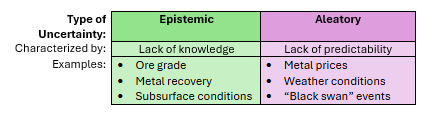
On the other hand, aleatory uncertainty refers to a lack of predictability and is fundamentally irreducible. In a mining context, this can include things like total precipitation next June, metal prices five years after startup, and the result of the next election. It also includes the dreaded “unknown unknowns” or “black swan events” that are both unpredictable and unidentifiable ahead of time. Aleatory uncertainty must be accepted because there is no way to reduce it; however, there are ways to understand it and manage its impact on your project. Most mining companies make no distinction between epistemic and aleatory uncertainty when addressing risk. Without this distinction, the correct approaches, methods, and tools can’t be applied to manage critical project risks.
The first step in managing aleatory uncertainty is to understand how it’s occurring by viewing it through the lens of complexity and frequency. The diagram below illustrates the interaction of frequency and complexity for aleatory uncertainty, and the following paragraphs explain each region in more detail.
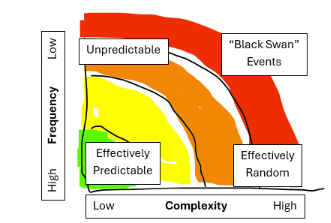
Low complexity and high frequency: These phenomena are effectively predictable with a useful model and relevant inputs. For example, project labour availability could be predicted by using total staffing numbers and historic attendance data. The remaining uncertainty reflects the quality of the model and the quality of the inputs.
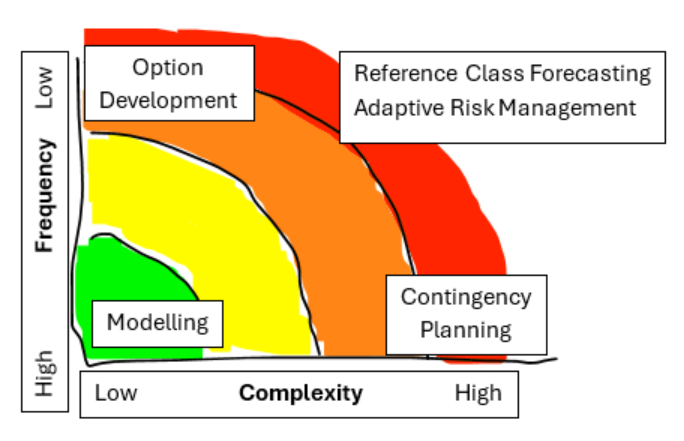
High complexity and low frequency: On the other extreme, we have “black swan” events and outcomes that, for practical purposes, cannot be foreseen. Because these events are unforeseeable, we have no choice but to accept that they may occur. However, we can survive them if we have appropriate financial reserves and robust methods for managing unforeseen risks. Practices like Reference Class Analysis can help by assigning budget and schedule reserves to cope with unforeseeable events, and tools like Adaptive Risk Management can help respond to these events in a structured way so the best decisions can be made in times of high uncertainty and limited information.
High complexity and high frequency: In these situations, we will observe an event with regularity, but we can’t predict any induvial outcome. Precipitation is a good example – it occurs frequently at many mine sites, but weather is so complex that precipitation is effectively unpredictable beyond a ~10-day time horizon. This type of risk can be managed by using probabilistic design criteria and making contingency plans. Continuing with the example of precipitation, we design mines and infrastructure for the 100-year or 200-year flood event because we can’t predict rainfall with any accuracy over the life of the mine; we then accept the risk of a 300-year flood event. Over a shorter time horizon, we can create production contingencies by stockpiling ore to keep the plant running if mining is paused during extreme rain events.
Low complexity and low frequency: In these situations, we probably understand the landscape of outcomes, but we can’t predict which one will occur ahead of time. Rolling a fair die is a perfect example. We know there is a 1/6th chance of the die landing on each number from 1 to 6; however, we can’t know which number will come up ahead of time and any guess only gives us a 1 in 6 chance of being correct. In this case, the uncertainty is driven by the fact that we only have one chance to get it right. In a mining context, this can include things like permitting, mine design, and key capital equipment selection – one-shot events with straightforward but uncertain outcomes. The inherent risk in these situations can be managed through the development of real options – advancing concurrent options and capitalizing on whichever outcome materializes. A company could advance projects to the permitting stage in several jurisdictions, then develop whichever is permitted first. Initial underground development could support several different mine plans, with the company pursuing whichever plan best fits ground conditions and metal prices at startup. An operator could split an initial, small haul truck order between two suppliers, then complete the fleet with the better performing trucks. When developing real options, the risk revolves around the resources spent on options that don’t get exercised.
The dimensions of complexity and frequency are not binary. In practice, many situations involve varying degrees of complexity and frequency, requiring these tools and approaches to be adapted and combined. There are many situations where modelling can support option development, reference class analysis can support contingency planning, and so on. The diagram below summarizes the landscape of solutions when dealing with aleatory uncertainty.
Many problems in mining projects are combinations of epistemic uncertainty (a lack of knowledge) and aleatory uncertainty (a lack of predictability). Epistemic uncertainty can be fundamentally reduced by increasing your knowledge, so you always have a choice about whether to accept the uncertainty or apply resources to reduce it. On the other hand, aleatory uncertainty is fundamentally irreducible, so this component of risk must be accepted. However, you can and should apply resources in the preparation and management of unpredictable events. While the tools and approaches in this article can’t make things more predictable in any fundamental way, they can put you in the best possible position to succeed no matter which future comes to pass. Ultimately, the biggest risk with aleatory uncertainty is pretending it doesn’t exist – crafting and executing a single, ridged plan, and leaving success up to chance.
Like a casino, mining projects do present you with many things that you cannot predict. However, with a clear understanding of the type of project risk you’re facing and the application of the right methods and tools, you can tip the odds in your favour.